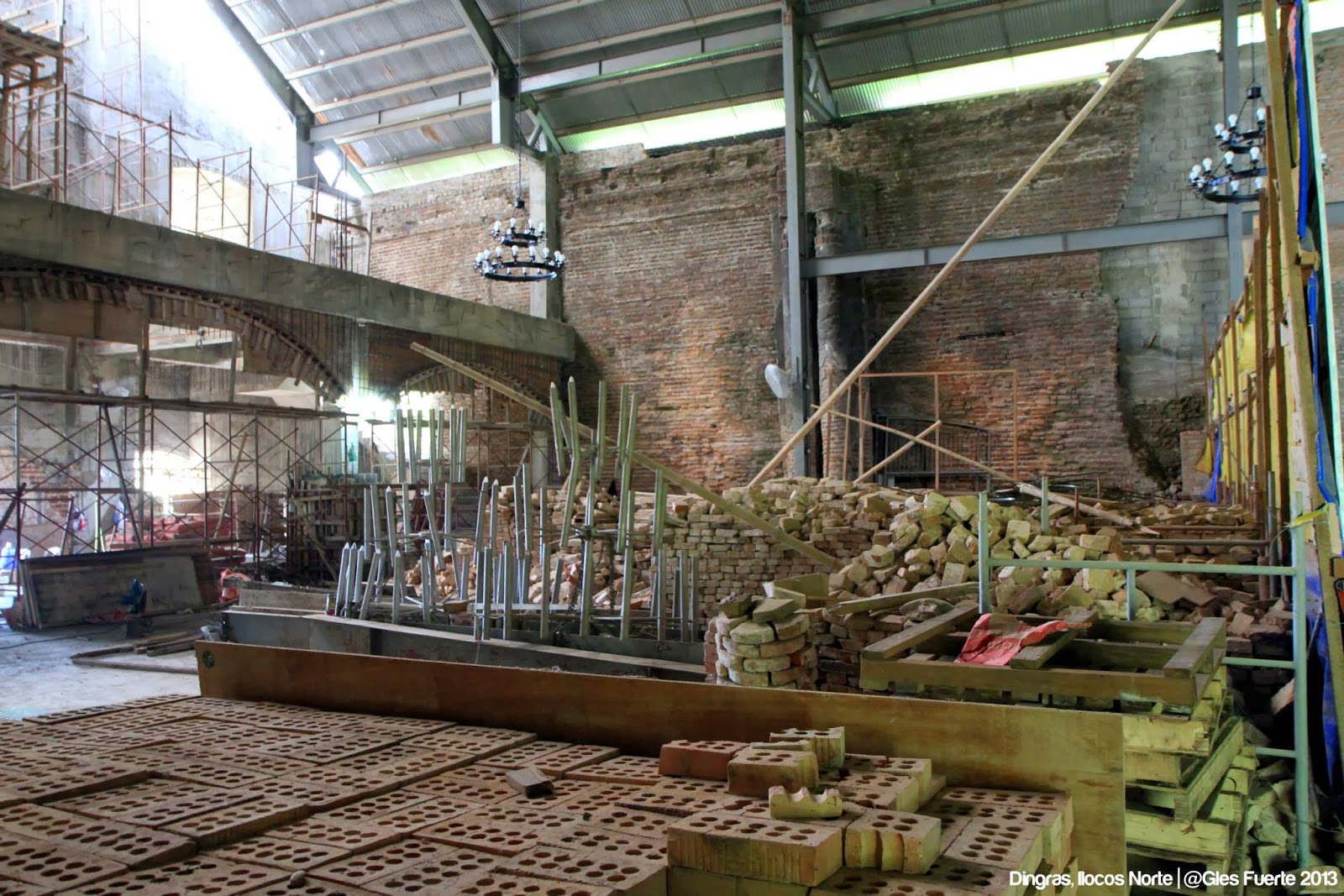
Dingras, officially the Municipality of Dingras (Ilocano: Ili ti Dingras; Filipino: Bayan ng Dingras), is a municipality in the province of Ilocos Norte, Philippines. According to the 2020 census, it has a population of 40,127 people distributed over 31 barangays.
Etymology
The Legend of Dingras
Legend has it that in the early times, there were two prosperous barangays in the present site of the town - each ruled by a powerful chief or datu. They were bitter and mortal enemies. Naslag was the powerful chief of the barangay north of the river, while Allawigan was the chief of the barangay to the south of the river.
One day, Allawigan and his warriors went out to go hunting. Ras, his son, was the bravest among them. During the hunt, Ras followed a deer that went north across the river. As he was chasing the deer, he saw a beautiful damsel gathering wildflowers on the opposite side of the riverbank. She was Ding, the daughter of Naslag. To help the lady, Ras gathered the most beautiful flowers near him, attached them to an arrowhead, and shot it over the river to land by the lady's feet. Ding looked at the other side of the river and waved her hands. Ras went home happily.
Ras begged his father for permission to win Ding for his wife; but because the fathers of Ding and Ras were bitter enemies, the only way he could win her was in an open battle fought fiercely between the two tribes.
Ras led his father's warriors. They fought valiantly and came out victorious in the end. Ras asked for Ding's hand as a prize, but Naslag refused. This angered him and hurled a challenge to the bravest warrior of Naslag in single combat with Ding as prize. The challenge was accepted. The combat was fought and again, Ras was victorious. He brought Ding triumphantly to Allawigan, his father. Thereafter, the people named the two barangays Dingras, after Ras, their valiant warrior ruler, and Ding, his wife.
History
On January 27, 2000, Mayor Robert Castro was forcibly removed from his office by the police due to defying orders from the regional trial court issued nine days prior to step down after losing an electoral contest to Oswaldo Parado, who was found to have won the 1998 mayoral race by over 370 votes.
Through Presidential Proclamation 680, September 20, 2024 was declared a special non-working day as tribute to Josefa Llanes Escoda, a World War II heroine and the Girl Scouts of the Philippines founder.
Geography
Dingras has a total area of 17,962 hectares, ranking 8th in size among the 23 municipalities and cities in the province. It accounts for practically 5.2% of the total land area of Ilocos Norte and corresponding percentage to the municipal area composed of 31 barangays. Six are on the Poblacion and 25 in the rural area. Out of the total area 6,305 hectares is devoted to rice and corn production. Other non-productive areas are devoted to livestock production, swine production and other livelihood projects. Most of the population are engaged in farming as the primary source of income.
Dingras is 21 kilometres (13 mi) from Laoag, 502 kilometres (312 mi) from Manila, 8 kilometres (5.0 mi) from Marcos, 9 kilometres (5.6 mi) from Solsona, and 18 kilometres (11 mi) from San Nicolas.
Barangays
Dingras is politically subdivided into 31 barangays. Each barangay consists of puroks and some have sitios.
Climate
Demographics
In the 2020 census, the population of Dingras was 40,127 people, with a density of 420 inhabitants per square kilometre or 1,100 inhabitants per square mile.
Economy
Poverty incidence of Dingras
Longest Bibingka
On October 9, 2007, Dingras, Ilocos Norte, Philippines sought a Guinness World Record certification after baking a kilometer-long "cassava bibingka" (native cake) made from 1,000 kilos of cassava and eaten by 1,000 residents.
List of Cultural Properties of Dingras
Government
Local government
Dingras, belonging to the second congressional district of the province of Ilocos Norte, is governed by a mayor designated as its local chief executive and by a municipal council as its legislative body in accordance with the Local Government Code. The mayor, vice mayor, and the councilors are elected directly by the people through an election which is being held every three years.
Elected officials
Notes
References
Bibliography
External links
- Philippine Standard Geographic Code
- Philippine Census Information
- Local Governance Performance Management System Archived 2012-05-02 at the Wayback Machine